
5 min read · Updated on July 17, 2026
Crossover: the invisible power thief in your freestyle pull
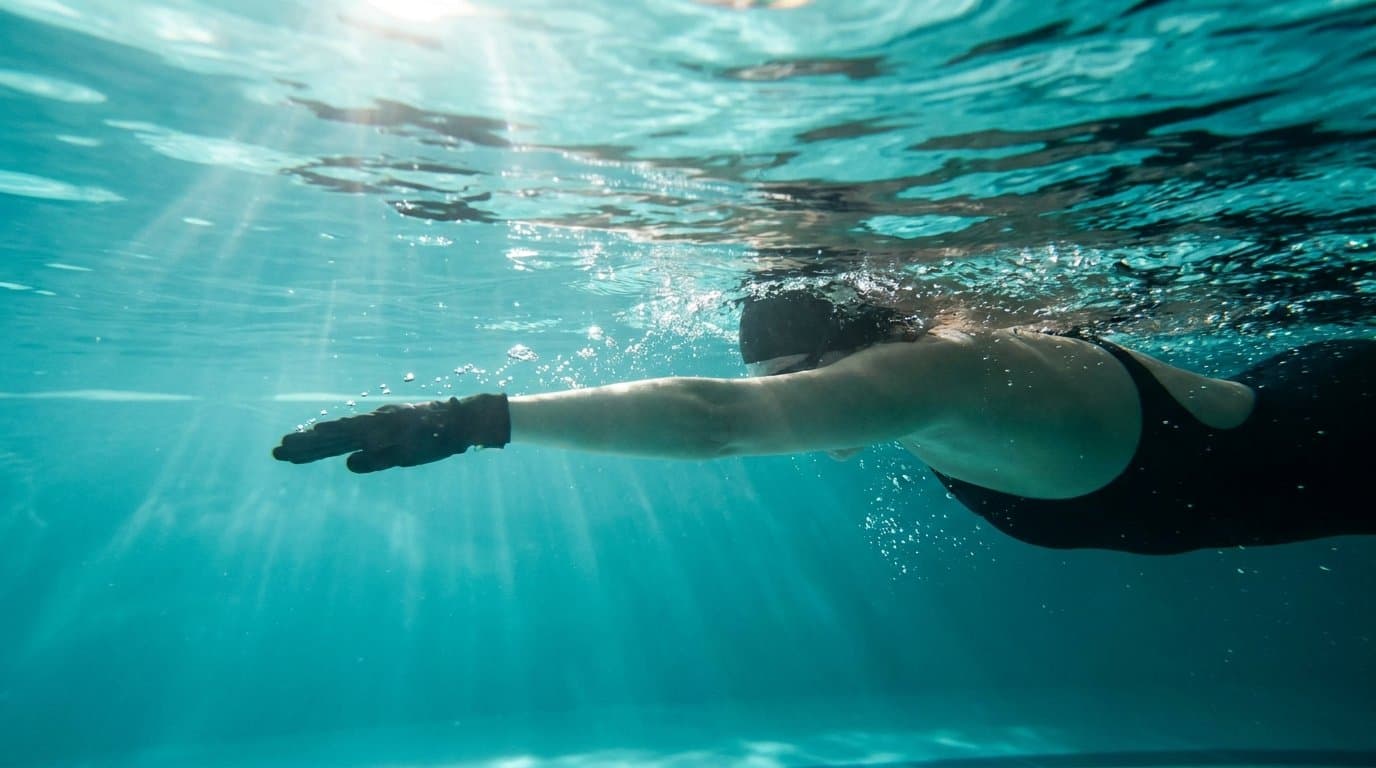
Some mistakes only show up on underwater video. Crossing the midline is one of them: the hand doesn't enter in front of the shoulder but wanders across your body's imaginary centreline to the other side. From above it looks harmless – underwater it's one of the biggest power thieves in freestyle.
The reason is physics: if the hand reaches diagonally across the middle, the following pull creates a sideways force. Your body responds by snaking, the legs scissor out, and part of your energy is lost to the side instead of going forward.
What really happens on a crossover
Propulsion only happens when you accelerate water straight backward. If your hand crosses the midline, it first pulls diagonally – the body is pushed off track around its long axis and fishtails.
This snaking increases your frontal area and therefore your drag. So you pay twice: less forward propulsion and more sideways braking.
Why your shoulder suffers too
A crossover forces the shoulder into an unfavourable, internally rotated position. Over thousands of strokes this increases friction in the shoulder joint and encourages the dreaded swimmer's-shoulder syndrome (impingement).
A clean entry line protects not only your speed but also your long-term health.
The fix: enter at shoulder width
Imagine two parallel lanes running straight forward from your shoulders. Each hand enters in its own lane – roughly shoulder width, never across the middle. The arm then extends straight forward before the catch begins.
The underwater pull stays on its side too: it runs straight back under the shoulder and hip, not in an S-curve across the body's centre.
- Enter in line with the shoulder, not across the middle.
- Extend straight forward after entry.
- Pull straight back under the body toward the hip.
- No crossing – keep two parallel lanes in mind.
How to make a crossover visible
Because you barely feel the mistake yourself, outside feedback helps: an underwater video analysis shows the entry line immediately. As a drill, swim along a line on the pool floor or deliberately “aim” at two imaginary points well in front.
This is exactly where structured technique training comes in: first make the mistake visible, then correct it in isolation before bringing it back into the full stroke.
Frequently asked questions
- What does crossover mean in freestyle swimming?
- A crossover means the hand crosses the body's imaginary centreline on entry or during the pull. As a result the arm pulls diagonally, the body snakes and part of the propulsion is lost sideways.
- Why does my body snake in freestyle?
- The most common cause is crossing the midline: the diagonal pull pushes the body off track and the legs scissor out. If each hand enters at shoulder width and you pull straight back, the snaking usually disappears.
- Is a crossover bad for the shoulder?
- Yes. A crossover rotates the shoulder inward and, over many strokes, raises the risk of irritation (impingement, swimmer's shoulder). An entry line at shoulder width relieves the joint.
- How do I know if I cross over?
- Most reliably through an underwater video analysis, because you barely feel the mistake yourself. As a self-test, swim along the floor line: if your hand crosses the line, you're crossing over.